· Health Guides · 11 min read
Medication Adherence Is Hard — Here's a Tool That Makes It Easier
Over half of chronic disease medications aren't taken as directed. Non-adherence causes up to 25% of hospitalizations. Here's why it fails and how ProCare Health fixes it.

It’s 7 PM. Your mother takes her blood pressure pill. She doesn’t take her diabetes pill. She’s not sure if she already took her evening pain medication, so she doesn’t take another one — just in case.
This isn’t a hypothetical scenario. It’s the daily reality for millions of caregivers managing medications for loved ones with chronic conditions. And it has real consequences.
The World Health Organization has called medication non-adherence a global priority, noting that improved compliance could have a greater impact on public health than advances in any single treatment. The numbers are stark:
- Over half the medications prescribed for people with chronic diseases are not taken as directed. (American Heart Association)
- Non-adherence is linked to up to 25% of all hospitalizations each year in the United States. (Dialog Health)
- Poor adherence contributes to 125,000 preventable deaths annually and costs the U.S. healthcare system up to $300 billion in avoidable expenses. (JCAHO / AHA)
- Among older adults, 10% of hospital admissions could be avoided with better medication adherence. (Dialog Health)
- 33% to 69% of hospital admissions related to medications are caused by non-adherence. (Dialog Health)
The problem isn’t that patients or caregivers don’t care. It’s that managing medications — especially for someone who can’t manage them themselves — is cognitively demanding, emotionally exhausting, and easy to get wrong when you’re juggling meals, symptoms, appointments, and sleep.
Here’s why medication adherence is so hard, and what actually helps.
Why Medication Adherence Fails
The Complexity Problem
Older adults with chronic conditions are often prescribed multiple medications. Polypharmacy — commonly defined as the concomitant use of five or more medications — affects 23% to 39% of older adults. Each additional medication adds cognitive load: different dosing schedules, different timing requirements (with food, on an empty stomach, avoid dairy), different pill sizes and shapes that are hard to distinguish.
For a caregiver managing medications for a parent, the complexity multiplies. You’re not just tracking one person’s regimen — you’re tracking yours too.
The Memory Problem
Even with perfect organization, memory fails. According to the CDC Grand Rounds, non-adherence is associated with higher rates of hospital admissions, suboptimal health outcomes, increased morbidity and mortality, and increased healthcare costs. But the CDC also notes that simple interventions — like reminders and tracking — can significantly improve adherence rates.
The gap between “I know I should track this” and “I’m actually tracking this at 7 PM when I’m tired” is where most medication management fails.
The Cost Problem
Not all non-adherence is forgetfulness. According to the National Health Statistics Reports (2021–2022), 3.6% of older adults did not get needed prescription medication due to cost, and 3.4% did not take medication as prescribed due to cost — skipping doses, delaying filling prescriptions, or taking less medication than prescribed. Among older adults in food-insecure families, cost-related non-adherence was six times higher than among those in food-secure families.
For some patients, the choice isn’t “did I remember?” It’s “can I afford to take this?”
The Cognitive Problem
Cognitive impairment and frailty significantly affect medication adherence in older adults. Declining memory, reasoning, and decision-making make self-management difficult. For patients with dementia or mild cognitive impairment, caregiver involvement is essential — and studies consistently show that caregiver involvement improves adherence rates from around 54% (for cognitively impaired patients managing alone) to 77–98% when caregivers are actively involved.
What Actually Works
The research is clear: no single intervention solves medication adherence. But a combination of strategies does:
1. Reliable Reminders
Medication reminders that persist across device restarts and don’t require an internet connection are the most basic and most effective tool. The WHO notes that “forgiving drugs” — those with a wide therapeutic window where a missed dose is less dangerous — are easier to manage, but for most medications, timely reminders are essential.
2. Simple Dose Logging
Tracking adherence isn’t about creating a perfect record. It’s about making it easy to note what happened. A one-tap “taken” button is infinitely more useful than a form that requires typing. Studies show that patients who use digital adherence tools report significantly higher compliance rates — not because the tool changes their behavior magically, but because it removes the friction between intention and action.
3. Visual Adherence History
Seeing a streak of taken doses builds motivation. Seeing a gap flags a problem early. According to a 2025 systematic review and meta-analysis in Drugs & Aging, interventions that combine digital reminders with adherence tracking showed significant improvements in medication compliance, with some studies reporting adherence gains of 25–59%.
4. Caregiver Supervision
For cognitively impaired patients, family support is the single most important factor in medication adherence. Studies from Frontiers in Aging show that caregiver involvement in therapeutic follow-up significantly improves adherence rates, especially in populations with dementia and schizophrenia. But caregivers need tools that make supervision easy — not another app to manage.
5. Cross-Referencing with Symptoms
Medication adherence doesn’t happen in a vacuum. A missed dose of a blood pressure medication might show up as elevated readings the next day. A skipped diabetes pill might correlate with symptoms of hyperglycemia. When medication logs are connected to symptom tracking, patterns emerge that help you and your doctor understand what’s working and what isn’t.
6. Allergy Safety Checks
A simple reminder app won’t stop a caregiver from accidentally logging a medication the patient is allergic to — but ProCare does. The app includes an Allergy Cross-Referencing Engine that checks every medication against the patient’s allergy profile before it can be saved. It catches not just exact matches (aspirin vs. aspirallergy) but cross-reactive drug classes too: a penicillin allergy triggers warnings for amoxicillin and augmentin; a sulfa allergy flags Bactrim and Septra. The system uses word-boundary regex matching to avoid false positives — it won’t confuse “sulfasalazine” with a simple “sulfa” allergy unless the match is clinically relevant. If a major conflict is detected, the save action is hard-blocked with a clear warning card. This isn’t a nice-to-have feature; for caregivers managing complex medication regimens, it’s a safety net that catches errors before they happen.
How to Build a Medication Tracking System That Actually Works
Start With the List
Write down every medication your loved one takes — name, dosage, frequency, timing instructions, prescribing doctor. Do this once, and update it every time anything changes. A current medication list is the foundation of everything else.
Set Reminders for Each Medication
Not just one daily alarm. Each medication that has a specific timing needs its own reminder. If a medication is taken “with breakfast,” the reminder should come at breakfast time, not at 8 AM general “medication time” when breakfast might be at 9.
Log Every Dose
This is the step most people skip. Logging doesn’t mean writing an essay. It means tapping “taken” when the dose is taken, or “missed” when it isn’t. Over time, this creates a record that tells you (and your doctor) the truth about adherence — not the version of the truth you remember.
Review Weekly
Once a week, look at the adherence data. Are there patterns? Are certain medications consistently missed? Is there a time of day when doses are most likely to be forgotten? This weekly review is where tracking becomes actionable.
Share With Your Doctor
At the next appointment, bring the adherence data. Doctors don’t have time to reconstruct your medication history from memory. A clear adherence record — showing which doses were taken, which were missed, and when — gives your doctor actionable information to adjust treatment.
How ProCare Health’s Medication Tracking Helps
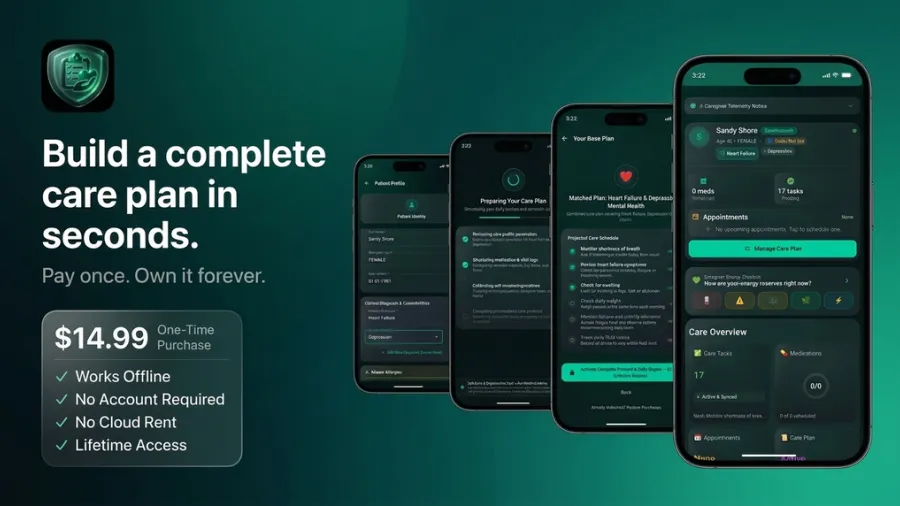
Medication adherence is one of the most common use cases for ProCare Health, and the app is built for the reality of caregiver life — not a tech demo:
- Clinical-grade allergy cross-referencing — Before any medication can be saved, it’s checked against the patient’s active allergy profile. The system catches exact matches and cross-reactive drug classes (penicillin → amoxicillin, sulfa → Bactrim) using word-boundary regex matching to avoid false positives. If a major conflict is detected, the save action is hard-blocked with a high-visibility warning card.
- 150+ built-in drug catalog — Search by generic name, brand name, or colloquial term. Typing “Metformin” auto-assigns the category “Antidiabetic,” sets default dosage units to “mg / tablet,” and triggers meal-time prompts (“With food”). If a medication isn’t in the database, write-in entries still undergo the full allergy check.
- PRN vs. scheduled medications — Distinguish between fixed-time schedules (daily, every N days, specific days of the week) and as-needed doses. Configure meal rules (before/after/with food), prescribing doctor, dispensing pharmacy, form factor (tablet, patch, liquid, inhaler), and storage requirements like refrigeration.
- One-tap dose logging with deduplication — When it’s time to take a medication, a single tap marks the dose as “taken,” “skipped,” or “missed.” If two caregivers log around the same time (within a 5-minute window), the system automatically merges entries instead of creating accidental double-doses.
- 7-day rolling reminder engine — Schedules are reconciled into deterministic daily reminders that persist across device restarts and work offline. No internet connection or cloud sync required.
- Chronological timeline view — The patient’s day is stratified into prioritized sections: Overdue (highlighted in high-alert red), Remaining Today, Completed, and an interactive As Needed (PRN) panel.
- Cross-referencing with symptoms — Medication logs are connected to the broader activity feed alongside vitals, symptoms, and observations. A missed blood pressure medication shows up in the same timeline as elevated readings, making it easy to spot cause-and-effect.
- CSV export & audit trail — Export timestamped Medication Administration Record (MAR) logs ready to hand to visiting nurses, hospice coordinators, or hospital discharge planners. Every dose tracks strict status transitions: SCHEDULED → TAKEN, SKIPPED, or MISSED, complete with reason notes for physician review.
None of this data leaves your phone. No cloud. No accounts. No tracking. Your medication data — as personal as it is — stays yours.
The Bottom Line
Medication adherence isn’t a willpower problem. It’s a system problem. When you’re managing medications for someone who can’t manage them themselves, the gap between knowing what needs to be done and actually doing it is where mistakes happen.
A simple tool that reminds you, logs what happened, and shows you the patterns over time can make the difference between consistent adherence and the kind of medication gaps that lead to hospitalizations.
You don’t need a perfect system. You need a system that’s simple enough to use at 7 PM when you’re tired.
This is not medical advice. Consult your healthcare provider for medical decisions. Medication management should always be guided by a qualified healthcare professional. This article discusses medication tracking practices and is not a substitute for professional medical guidance.
Track medications and adherence in ProCare Health. Set reminders, log doses, monitor adherence. All your data stays on your device. No account required.
References
WHO — Medication Adherence: WHO Cares? — World Health Organization, landmark report on the global impact of medication non-adherence and strategies for improvement. ncbi.nlm.nih.gov/pmc/articles/PMC3068890/
Medication Adherence — American Heart Association — AHA, “Medication Adherence: Taking Your Meds as Directed.” Estimated that over half the medications prescribed for chronic disease are not taken as directed; 125,000 preventable deaths annually; $300 billion in costs. heart.org/en/health-topics/consumer-healthcare/medication-information/medication-adherence-taking-your-meds-as-directed
CDC Grand Rounds: Improving Medication Adherence for Chronic Disease Management — Centers for Disease Control and Prevention, clinical review of adherence interventions and their impact on hospital admissions, morbidity, and mortality. cdc.gov/mmwr/volumes/66/wr/mm6645a2.htm
Patient Adherence Statistics 2025 — Dialog Health, comprehensive review of adherence statistics: 25% of hospitalizations linked to non-adherence, 33–69% of medication-related admissions caused by non-adherence, 10% of older adult hospital admissions potentially avoidable with better adherence. dialoghealth.com/post/patient-adherence-statistics
Medication Non-adherence in Older Adults — Springer Nature, Drugs & Aging, systematic review of underlying factors, potential interventions and outcomes for older adults with polypharmacy. link.springer.com/article/10.1007/s40266-025-01249-7
Prescription Medication Use, Coverage, and Nonadherence Among Adults Age 65 and Older — National Health Statistics Reports (2021–2022), CDC/NCHSR data on cost-related non-adherence: 3.6% of older adults did not get needed prescription medication due to cost; 3.4% did not take medication as prescribed due to cost. ncbi.nlm.nih.gov/books/NBK608618/
Multilevel Interventions to Improve Medication Adherence in Older Adults — Cureus, systematic review and meta-analysis (2015–2025) of cognitive, digital, behavioral, and socioeconomic strategies. Caregiver involvement improved adherence from 54.2% to 77–97.6% in cognitively impaired populations; digital tools showed significant adherence gains. ncbi.nlm.nih.gov/pmc/articles/PMC11855123/
Medication Adherence in Older Adults with Chronic Diseases — Frontiers in Aging, scoping review of barriers, facilitators, and effective interventions. Non-adherence ranges from 20–55% in older adults; caregiver involvement and digital tools are consistently associated with improved adherence. frontiersin.org/journals/aging/articles/10.3389/fragi.2026.1642652/full
Polypharmacy in Older Adults — Springer, Drugs & Aging, definition and clinical implications of polypharmacy (5+ medications) in older adults: 23–39% of older adults consume five or more medications simultaneously; linked to falls, drug interactions, non-adherence, hospitalizations, and deaths. link.springer.com/article/10.1007/s40266-025-01249-7
Preventable Drug-Related Hospital Admissions — Winterstein et al., Annals of Pharmacotherapy, study on the impact of preventable medication-related hospital admissions and the role of adherence monitoring. doi.org/10.1345/aph.1A225