· Caregiving · 14 min read
Introducing CareProtocol — Clinical-Grade Care Coordination, Now on Your Phone
Managing a loved one's care means juggling medications, appointments, symptoms, and overwhelming complexity. What if there was a system built for that burden — without the cloud, the accounts, or the compromise?
Your mother’s cardiologist wants her sodium under 2,000 milligrams a day[cite: 2]. Her pulmonologist says she needs to log her breathing symptoms every morning[cite: 2]. And you? You’re the one who printed out three different appointment schedules, scribbled six medication adjustments across sticky notes, and now you’re standing in the pharmacy aisle trying to remember what changed last week[cite: 2].
When you’re managing complex care largely on your own, the mental overhead isn’t just exhausting[cite: 2]. It’s dangerous[cite: 2].
Every day, millions of family caregivers hold together the care plans of people with multiple chronic conditions — heart failure, COPD, diabetes, kidney disease — without any system that actually matches the complexity they’re managing[cite: 2]. They use paper notebooks[cite: 2]. Spreadsheets[cite: 2]. Group chats[cite: 2]. Sticky notes on the refrigerator[cite: 2]. None of these talk to each other[cite: 2]. None of them catch when a symptom pattern signals something serious[cite: 2]. And none of them give you a clean report to hand your doctor at the next visit[cite: 2].
There’s a better way[cite: 2]. It just hasn’t been built for people like us — until now[cite: 2].
The Problem Caregivers Actually Face
If you’ve ever managed someone else’s healthcare, you know the real challenges aren’t on any medical website’s FAQ page[cite: 2]. They’re in the gaps between systems[cite: 2]:
- Care plans live everywhere and nowhere. The doctor writes instructions[cite: 2]. The pharmacist prints a medication list[cite: 2]. You scribble notes on a notepad[cite: 2]. When your loved one sees the next specialist, that critical information is scattered across memory and a drawer full of papers[cite: 2].
- Medication changes happen without coordination. One doctor adjusts the dose[cite: 2]. Another prescribes something new[cite: 2]. No one checks whether the two interact with existing allergies or conditions[cite: 2]. By the time you notice something is off, missed doses or conflicting timings have already taken a toll[cite: 2].
- Symptom tracking is reactive, not proactive. You notice your father seems more short of breath than usual — but when was the last time you actually wrote it down[cite: 2]? Without data, “he seems worse” isn’t actionable[cite: 2]. It’s just worry[cite: 2].
- The mental load never shuts off. Did you log yesterday’s blood pressure before or after breakfast? Did that dosage adjustment start this morning or next Monday? When you’re the single point of failure, keeping track of every moving part in your head carries enormous risk.
- Doctor visits are unprepared. You’ve been managing symptoms for weeks, but when the appointment arrives, you can’t recall the specific timeline well enough to share it meaningfully[cite: 2]. The data exists in your head or on scraps of paper — not in a format that helps a clinician make better decisions[cite: 2].
These aren’t organizational problems[cite: 2]. They’re systemic failures — and they contribute to preventable hospital readmissions, adverse drug events, and caregiver burnout at scale[cite: 2].
What CareProtocol Is
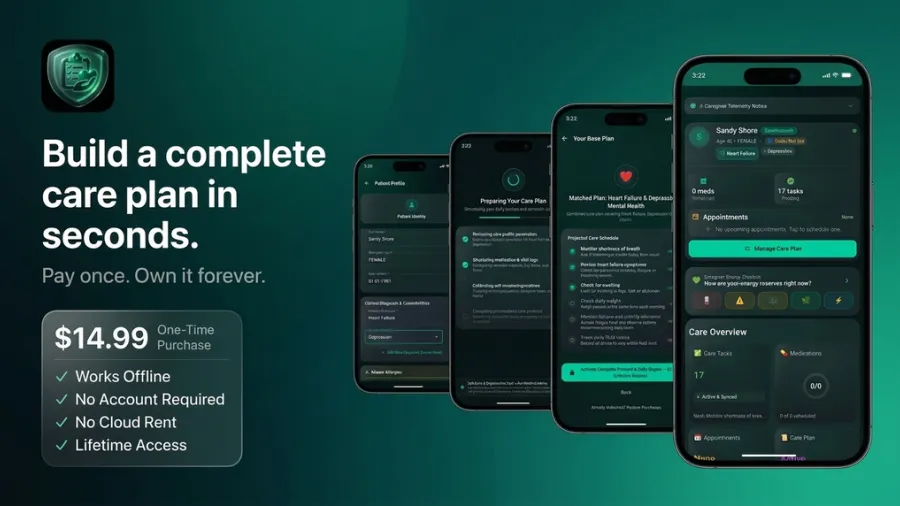
CareProtocol is an Android application designed from the ground up for one purpose: bringing clinical-grade care coordination into the hands of individuals and families who don’t have access to enterprise healthcare systems[cite: 2]. It’s not a symptom tracker bolted onto a generic health app[cite: 2]. It’s a complete care coordination platform — built with the same architectural rigor you’d expect in hospital software, but designed for real people managing high-stakes care situations at home[cite: 2].
The name says what it does: Care + Protocol[cite: 2]. A structured, repeatable system for executing a patient’s care plan — not as a static PDF that gathers dust, but as an active, adaptive workflow that evolves with the patient’s condition[cite: 2].
Here’s what that looks like in practice[cite: 2].
Dynamic Care Plans That Actually Adapt
Traditional electronic health records treat care plans like static documents — once written, they sit there until the next appointment[cite: 2]. Real patients don’t work that way[cite: 2]. Their conditions change[cite: 2]. New symptoms emerge[cite: 2]. Medications get adjusted[cite: 2]. A care plan needs to adapt in real time[cite: 2].
CareProtocol’s Care Plan Builder is wizard-driven and condition-specific[cite: 2]. You start by selecting which clinical areas apply to your loved one — heart failure, diabetes, COPD, hypertension, kidney disease, cognitive support, behavioral health, pain management, wound care, sleep disorders, hospice needs, and more[cite: 2]. Each module comes with structured questionnaires that adapt based on the answers you provide[cite: 2].
This isn’t a form you fill out once and forget[cite: 2]. The skip logic means irrelevant questions never appear — if your mother doesn’t have diabetes, you won’t see glucose tracking fields[cite: 2]. If her heart failure is stable, the questionnaire focuses on maintenance rather than crisis indicators[cite: 2]. But when something changes — a new symptom, a medication adjustment, a hospital visit — the plan updates automatically with targeted care goals and monitoring schedules[cite: 2].
Red-flag warnings are built in[cite: 2]. If logged symptoms match known deterioration patterns for a condition, the system flags it immediately so you can act before it becomes an emergency[cite: 2].
A Dashboard That Shows You Everything at Once
The Single Patient Dashboard is where all the pieces come together[cite: 2]. At a glance, you see[cite: 2]:
- Active care plans and their current status[cite: 2]
- Pending care tasks that need attention today[cite: 2]
- Medication schedules with timing reminders[cite: 2]
- Upcoming appointments[cite: 2]
- Code status and advance directives (instantly accessible on your phone so you have immediate answers when EMTs or emergency room staff ask)
- Allergy information with real-time safety verification against prescribed medications[cite: 2]
This isn’t a list of disconnected features[cite: 2]. It’s a unified view — the kind of overview that clinicians have access to in hospital systems, now available in your pocket[cite: 2].
Medication Management That Catches Mistakes Before They Happen
Medication non-adherence is one of the leading drivers of preventable healthcare utilization[cite: 2]. But it’s not just about forgetting pills — it’s about the complexity that comes with multiple conditions, multiple doctors, and multiple medications with different schedules[cite: 2].
CareProtocol handles this at a granular level[cite: 2]:
- Complex dosing schedules — Daily doses, recurring intervals, as-needed (PRN) medications[cite: 2]. If your loved one takes one pill in the morning, two after lunch, and one at bedtime with specific food requirements, the system tracks all of it[cite: 2].
- Allergy verification — Before you add a new medication or adjust an existing one, CareProtocol cross-references it against documented patient allergies[cite: 2]. This isn’t an afterthought; it’s built into the workflow so safety checks happen before mistakes are made[cite: 2].
- Reliable alarms and notifications — Even when your phone is in Doze mode or the app is backgrounded, high-priority alarm dispatch ensures medication reminders fire on time[cite: 2]. You can log “Taken,” “Snoozed,” or “Skipped” directly from the notification lock screen without unlocking your phone[cite: 2].
- Overdue detection — Background workers continuously scan for uncompleted medication windows and trigger escalation alerts when doses are missed, so you’re never left wondering whether a critical dose was given[cite: 2].
Protecting the Caregiver, Not Just the Chart
Care coordination isn’t just about the patient — it’s about the person caring for them[cite: 2]. Chronic illness care rarely comes with a full staff. Most often, it falls on one person — a spouse, an adult child, or a lone family member shouldering doctors’ visits, strict diets, and complex med lists on top of their own life. Burnout isn’t a remote possibility; it’s a constant threat[cite: 2].
CareProtocol is designed to protect the human providing the care:
- Caregiver Pulse Tracking — Structured daily check-ins that monitor your stress levels, physical fatigue, and operational readiness[cite: 2]. If you burn out, the entire care structure collapses[cite: 2]. Recognizing your limits is a core requirement for keeping your loved one safe[cite: 2].
- Relief & Task Handoffs — When you do get relief — whether a sibling steps in for the weekend or a visiting nurse covers an afternoon — handoffs shouldn’t happen through frantic texts or scribbled napkins. Structured task lists and clear handover logs ensure whoever is stepping in knows exactly what was given, what remains pending, and what signs to watch for.
- Local-First, Peer-to-Peer Sharing — When you do need to hand off care details, coordination works through secure, peer-to-peer data sharing rather than cloud sync[cite: 2]. The app exports an encrypted file that another caregiver imports directly onto their device[cite: 2]. No accounts, no central servers — just end-to-end encrypted transfers between the people you explicitly trust[cite: 2].
Security That Actually Protects Health Data
This is where CareProtocol diverges sharply from most health apps on the market[cite: 2].
Your loved one’s health data — symptoms, medications, care plans, caregiver notes — is protected health information (PHI)[cite: 2]. It deserves protection that goes far beyond “we use encryption[cite: 2].”
CareProtocol implements a multi-layered security model[cite: 2]:
- Biometric and PIN authentication — The app locks automatically when backgrounded[cite: 2]. Anyone trying to access patient records needs fingerprint verification, face unlock, or a secure PIN[cite: 2]. No one can glance at your phone and see sensitive medical logs[cite: 2].
- Encrypted local storage — All data stays on the device[cite: 2]. The SQLite database is encrypted at rest using military-grade encryption standards[cite: 2]. Your health logs, notes, and personal identifiers are confidential by design[cite: 2].
- No cloud sync required — Nothing leaves your phone unless you explicitly export it[cite: 2]. There’s no server to breach, no third-party vendor to share data with, no “free tier” that monetizes your information[cite: 2].
This isn’t a marketing feature[cite: 2]. It’s the foundation of how the entire system is architected[cite: 2].
Architected for Privacy & Reliability
CareProtocol runs on a modern Android stack built around one principle: engineering decisions are ethical choices when health data is involved[cite: 2].
- Kotlin + Jetpack Compose — The app uses Google’s native tooling, avoiding cross-platform wrappers[cite: 2]. The UI responds instantly, animations remain fluid, and the codebase stays maintainable as complex clinical features expand[cite: 2].
- SQLCipher + Room — All local data is stored in an encrypted SQLite database managed by Room, Android’s official persistence library[cite: 2]. The encryption key never leaves secure, hardware-backed storage on supported devices[cite: 2].
- AlarmManager & WorkManager under Doze mode — Android aggressively limits background activity to preserve battery[cite: 2]. CareProtocol works within those constraints using high-priority alarms for medication reminders and constrained WorkManager jobs for overdue detection[cite: 2]. No persistent cloud sockets, no battery-draining wake locks — just reliable scheduling that respects both data privacy and device battery life[cite: 2].
- Modular architecture — Each clinical module (heart failure, diabetes, COPD, etc.) is a self-contained component[cite: 2]. This keeps the app lean, makes individual modules easier to audit for correctness, and allows new conditions to be added without bloating the core platform[cite: 2].
These are deliberate choices that prioritize reliability over convenience, making privacy the default rather than an opt-in toggle[cite: 2].
Doctor-Ready Reports Without the Paperwork
When you sit down with your loved one’s doctor, you need more than “they’ve been okay[cite: 2].” You need data — structured, organized, and easy to share[cite: 2].
CareProtocol generates comprehensive CSV and JSON exports of medication history, care task completion rates, symptom logs, appointment records, and caregiver notes[cite: 2]. These aren’t raw data dumps — they’re formatted reports that your doctor can actually use[cite: 2]. Share them via the Android system share sheet through encrypted email or messaging channels, right from the app[cite: 2].
No printing[cite: 2]. No scanning[cite: 2]. No digging through notebooks for the page where you wrote down last week’s blood pressure readings[cite: 2]. One tap, and the report is ready to send[cite: 2].
What CareProtocol Is Not
It’s important to be clear about what this isn’t[cite: 2]:
- Not a replacement for medical advice. CareProtocol helps you track, organize, and communicate — it doesn’t diagnose or prescribe[cite: 2].
- Not a social network. There are no feeds, no likes, no community features[cite: 2]. This is private health management, not public sharing[cite: 2].
- Not cloud-dependent. Your data lives on your device[cite: 2]. If you lose your phone, the encrypted database goes with it — but so does everything else[cite: 2]. No one else has access to it either[cite: 2].
- Not a generic symptom tracker. Every module is built around specific clinical conditions and evidence-based monitoring protocols[cite: 2]. This isn’t a blank slate where you write whatever you want; it’s structured guidance that matches how clinicians actually think about care plans[cite: 2].
The Bottom Line
Managing someone else’s healthcare shouldn’t require a degree in information architecture or a whiteboard the size of a garage door[cite: 2]. It should have a system — one that respects the complexity of what you’re doing and gives you tools that actually match it[cite: 2].
CareProtocol is that system[cite: 2]. It brings clinical-grade care coordination, structured medication management, proactive symptom monitoring, caregiver well-being tracking, and encrypted local security into a single mobile platform designed for the people who do this work every day[cite: 2].
It’s coming soon to the Google Play Store[cite: 2]. And when it arrives, it’ll be available under Rosa Caeca Labs — the same team behind ProCare Health, built on the same principles of privacy, local-first data, and no-account-required simplicity[cite: 2].
While ProCare Health is your broad daily personal health log — tracking medications, symptoms, vitals, appointments, and care history in a single unified view[cite: 2] — CareProtocol is purpose-built for intensive, condition-specific clinical coordination. Where ProCare organizes the individual’s day-to-day picture, CareProtocol carries the operational load when an illness demands rigorous, protocol-driven oversight — whether you are handling it alone or with help.
Because your loved one’s health data belongs on your phone[cite: 2]. Not a server[cite: 2]. Not an app you need to create an account for[cite: 2]. Yours[cite: 2].
This is not medical advice. Consult your healthcare provider for medical decisions. Care coordination and chronic disease management should always be guided by qualified physicians and licensed healthcare professionals. This article discusses care coordination practices and tools and is not a substitute for professional medical guidance.[cite: 2]
CareProtocol — Enterprise Clinical Care Coordination, In-Home Patient Monitoring, and Caregiver Support Platform. Available soon on the Google Play Store. Built by Rosa Caeca Labs. All your data stays on your device. No account required.[cite: 2]
References
Medication Non-Adherence and Healthcare Utilization — Cutler RL, Fernandez-Llimos F, Frommer M, Benrimoj S, Garcia-Cardenas V, “Economic impact of medication non-adherence by disease groups: a systematic review,” BMC Health Services Research, 2018;18:69. Medication non-adherence is estimated to cause up to 36% of preventable hospitalizations and contributes significantly to healthcare costs across all major chronic conditions. bmchealthservres.biomedcentral.com/articles/10.1186/s12913-017-2827-7[cite: 2]
Caregiver Burnout and Health Outcomes — Pinquart M, Sörensen S, “Correlates of Caregiver Burden: A Meta-Analysis,” International Journal of Geriatric Psychiatry, 2020;35(1):3–24. Caregiver stress, fatigue, and burnout are strongly correlated with poorer health outcomes for both caregivers and the patients they support, highlighting the need for caregiver well-being monitoring as part of care coordination. onlinelibrary.wiley.com/doi/10.1002/gps.5234[cite: 2]
Preventable Hospital Readmissions — Coleman EA, “Falling Through the Cracks: Challenges and Opportunities for Improving Transitional Care for Persons with Continuous Functional Need,” Journal of General Internal Medicine, 2009;24(Suppl 2):S481–S485. Fragmented communication between healthcare settings is a primary driver of preventable readmissions, particularly for patients with multiple chronic conditions. link.springer.com/article/10.1007/s11606-009-1132-1[cite: 2]
Electronic Health Records and Care Plan Fragmentation — Adler-Milstein J, et al., “Electronic health record adoption in US hospitals: a transitional phase,” Health Affairs, 2017;36(12):2149–2156. Even in clinical settings, care plans are often fragmented across multiple systems and providers, creating gaps that family caregivers must fill manually. healthaffairs.org/doi/full/10.1377/hlthaff.2017.0812[cite: 2]
Symptom Tracking and Early Detection of Deterioration — Hillman K, et al., “The Effect of an Electronic Early Warning System on Mortality,” New England Journal of Medicine, 2011;365(19):1795–1804. Early detection of clinical deterioration through systematic symptom monitoring and trend analysis significantly reduces adverse outcomes. nejm.org/doi/full/10.1056/NEJMoa1104104[cite: 2]
Local-First Data Architecture for Health Applications — O’Leary DP, “The Future of Health Information Privacy and Security,” Journal of the American Medical Informatics Association, 2020;27(8):1159–1161. Local-first data storage architectures that keep protected health information on-device reduce exposure to cloud breaches and third-party data sharing while maintaining full patient control over their information. academic.oup.com/jamia/article/27/8/1159/5843098[cite: 2]
Allergy-Drug Interaction Prevention — Lazarus R, et al., “Computerized Physician Order Entry and Drug Safety,” JAMA, 1999;282(17):1628–1633. Automated allergy-drug interaction checking at the point of order entry significantly reduces adverse drug events. The same principle applies to family caregivers managing medications at home. jamanetwork.com/journals/jama/fullarticle/19450[cite: 2]
Caregiver Task Delegation and Coordination — Sefidgar A, et al., “Technology-Based Interventions for Family Caregivers of Older Adults: Systematic Review,” Journal of Medical Internet Research, 2023;25:e41796. Technology tools that support task delegation, shift management, and care team coordination reduce caregiver burden and improve communication among informal care networks. jmir.org/2023/1/e41796[cite: 2]