· Caregiving · 10 min read
5 Signs Your Caregiver Should Start Tracking Wound Healing at Home
A surgical incision that won't close. A pressure sore on a bedbound parent's heel. If your loved one has risk factors for slow healing, daily tracking isn't just helpful — it's the difference between catching a problem when it's manageable and discovering it when it's an emergency.

5 Signs Your Caregiver Should Start Tracking Wound Healing at Home
Wounds don’t always announce themselves with dramatic symptoms. A surgical incision that takes longer to close than expected. A pressure sore that develops on a bedbound parent’s heel. A diabetic foot ulcer that seems stable one week and worse the next. By the time you notice something is wrong, the window for easy intervention may have closed.
For caregivers managing wounds at home, the difference between a smooth recovery and a serious complication often comes down to one thing: consistent, early tracking.
Clinical guidelines from the Wound, Ostomy and Continence Nurses Society (WOCN), the Centers for Disease Control and Prevention, and the American College of Physicians all emphasize a common principle: wounds should be assessed and documented regularly, and any wound that has not started to heal within two weeks or has not completely healed within six weeks should be evaluated by a wound care specialist. The problem is that caregivers can’t assess what they’re not looking at every day.
Here are five signs that it’s time to start tracking wound healing at home — and how to do it effectively.
1. The Wound Hasn’t Improved in Two Weeks
This is the most important threshold. According to the National Library of Medicine’s Medical Encyclopedia, a wound that has not started to show signs of healing within two weeks is considered a non-healing wound. If it hasn’t completely healed within six weeks, it requires professional evaluation at a wound care center.
But here’s the problem: wounds heal slowly, and slow change is invisible to the untrained eye. A caregiver looking at a wound daily may not notice that it’s 2% smaller than last week — or that it’s 2% larger. Without consistent documentation, “no improvement” feels like a sudden discovery rather than a trend.
What to track: Measure the wound’s length and width at each dressing change, using the same orientation each time (head-to-toe for length, side-to-side for width). Take a photo in the same lighting. Compare weekly, not daily.
2. The Patient Has Risk Factors That Slow Healing
Not all wounds heal at the same rate. Several conditions significantly impair the body’s ability to repair tissue:
- Diabetes: Elevated blood sugar impairs circulation and immune function, making diabetic foot ulcers particularly prone to chronic non-healing and infection. The CDC notes that people with diabetes are at higher risk for foot ulcers that can progress to deep tissue infection or amputation if not caught early.
- Poor circulation: Arterial or venous insufficiency reduces blood flow to the wound site, depriving it of the oxygen and nutrients needed for repair.
- Limited mobility: Bedbound or chair-bound patients are at risk for pressure injuries. The WOCN identifies pressure as the most common preventable cause of new wounds in immobile patients.
- Weakened immune system: From age-related immune decline to immunosuppressive medications, a compromised immune system delays the inflammatory phase of healing and increases infection risk.
- Advanced age: Older skin is thinner, less elastic, and slower to regenerate. The National Institute on Aging notes that wound healing slows considerably with age due to reduced cellular activity and blood flow.
If your loved one has any of these risk factors, daily tracking isn’t optional — it’s essential. A wound that might heal in two weeks for a healthy person could stall for months in a diabetic patient, and only consistent tracking catches that stall early enough to intervene.
This is especially true if the patient also manages chronic conditions like heart failure. Diabetic patients often have multiple comorbidities, and symptom tracking for one condition frequently overlaps with wound care needs. How to log heart failure symptoms covers the same daily-tracking discipline applied to cardiovascular monitoring — weight, breathing, swelling, heart rate, fatigue. The methodology is identical: catch incremental change before it becomes an emergency.
3. The Wound Type Is Known to Be Slow-Healing
Some wounds simply take longer by nature. According to clinical wound care guidelines, healing timelines vary dramatically by type:
- Post-surgical wounds: Typically heal in 2–4 weeks for simple incisions. Deeper surgical wounds may take longer.
- Pressure injuries (bedsores): Healing depends on the stage (1–4 based on depth). Stage 1 and 2 may heal in weeks with proper offloading; Stage 3 and 4 (deep tissue and unstageable) can take months and often require specialized wound care.
- Diabetic foot ulcers: Often require months of specialized treatment. Without proper care, they can progress to osteomyelitis (bone infection) or amputation.
- Venous leg ulcers: Caused by poor blood return from the legs. These are notoriously slow to heal and have high recurrence rates.
- Arterial ulcers: Caused by insufficient blood flow to the wound site. These often require vascular assessment and may not heal without addressing the underlying circulation problem.
If the wound type is one of the slow-healing categories, tracking becomes critical not just for monitoring progress but for knowing when to escalate to a wound specialist.
4. You’re Managing the Wound Between Professional Visits
If your loved one sees a visiting nurse, home health aide, or wound care specialist, there are likely days between visits when you’re managing the wound alone. During those days, you need to know:
- Is the wound improving, stable, or worsening?
- Is the current dressing appropriate, or does it need to change?
- Are there new signs of infection that need immediate attention?
Without a tracking system, the answer to these questions is often “I’m not sure until the next visit.” But waiting for a scheduled visit to notice a worsening wound is exactly how small problems become emergencies.
What to track: Document drainage (amount, color, consistency), surrounding skin condition (redness, warmth, swelling), and any pain or odor at each dressing change. Note whether the dressing stayed in place and whether it’s absorbing drainage appropriately.
5. There’s Been a Change in the Wound’s Appearance
Wounds can change direction quickly. A wound that’s been healing steadily can develop an infection overnight. A wound that’s been stable can suddenly deepen if necrotic (dead) tissue is exposed. According to the CDC’s wound care guidelines, healthcare providers should observe wounds for signs of infection at every assessment and promptly treat any infected wound.
The signs that a wound may be changing for the worse include:
- New or worsening redness around the wound edges that’s spreading outward
- Increased warmth in the surrounding tissue
- New or increased swelling
- Change in drainage — from clear to cloudy, from light to dark, from minimal to heavy
- New foul odor — a sign of infection or anaerobic bacterial colonization
- Increased pain at the wound site
- Appearance of slough (yellow/whitish tissue) or eschar (black/dark brown necrotic tissue) on the wound bed
- Wound suddenly larger or deeper
These changes don’t always mean infection. But they mean the wound needs reassessment, and if you’re managing it at home, you need to catch them before the next scheduled visit.
What to Track: A Caregiver’s Wound Log
Here’s what to document at each check or dressing change:
| What to Track | Why It Matters | How to Record |
|---|---|---|
| Wound size (length × width × depth) | Healing = getting smaller. Stalling or growing = needs attention. | Measure with a ruler at each dressing change. Same orientation every time. |
| Wound bed appearance | Tissue type tells you the healing phase. | Note: granulation (pink/red = healthy), slough (yellow/white = dead tissue), eschar (black = necrotic), epithelialization (pink/smooth = new skin forming). |
| Drainage (amount, color, consistency) | Changes in drainage often signal infection or healing progression. | Clear/yellow = normal early healing. Cloudy, green, or foul-smelling = possible infection. Sudden increase = may need dressing change cadence adjusted. |
| Surrounding skin | Redness, warmth, or swelling around the wound can indicate spreading infection. | Note redness perimeter, warmth, tenderness. Use a pen or ruler to mark the edge of redness if it’s spreading. |
| Pain level | Increasing pain can signal infection, pressure, or tissue damage. | Use a simple scale: 1 (minimal) to 5 (severe). Note what triggers it. |
| Photos | The most reliable way to see incremental change. | Take in the same lighting, same angle, same scale. Compare weekly. |
How ProCare Health’s Wound Tracking Helps
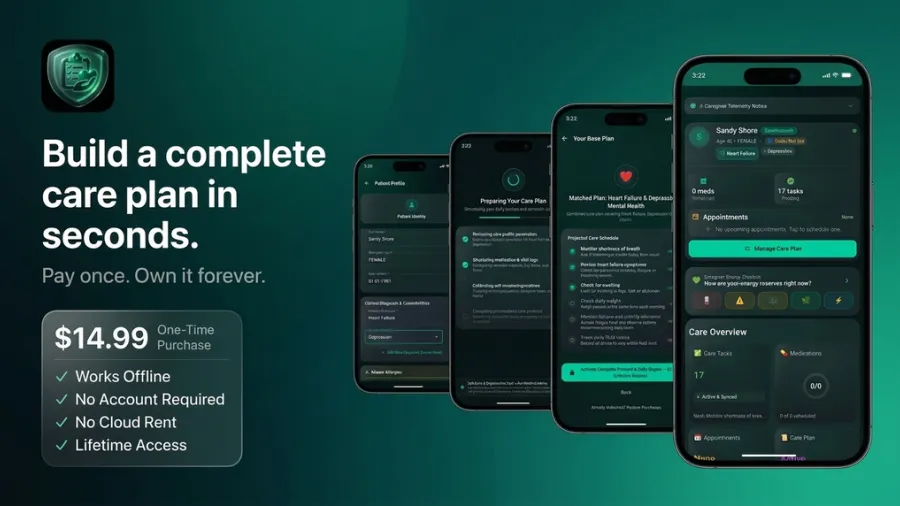
This is exactly why ProCare Health includes a dedicated Wound tracking category — built for the same bedside reality you’re living. The logging workflow is designed for caregivers who need to document quickly, without typing:
- Emoji-first wound classification — tap a card to select the wound type (pressure ulcer, laceration, surgical incision, skin tear, burn, bruise, infection, or other) and tap again for the body location (leg, foot, arm, hand, chest, head/face, buttock, back). No typing required.
- Severity grading with color-coded indicators — choose from Minor (green), Moderate (amber), Severe (orange), or Critical (red), with size presets (small < 2 cm, medium 2–5 cm, large > 5 cm).
- Caregiver notes — freeform text for dressing type, drainage appearance, odor, and patient tolerance.
- Visual healing timeline — chronological view of all wound logs with color-coded severity tags, wound type, and body location, so you can see healing progression at a glance.
- Care plan integration — ProCare generates automatic daily infection checks, pain assessments, dressing change schedules, and offloading reminders based on the wound type you log.
- CSV export — export wound care events in standardized clinical format (type, location, size, severity, timestamp, notes) to share with visiting nurses, physicians, or hospice coordinators.
- Cross-referencing — wound logs are automatically connected to related tracking: diabetes care (diabetic foot ulcer monitoring), Skin Integrity & Positioning (repositioning schedules), and Pain Management.
None of this data leaves your phone. No cloud. No accounts. No tracking. Your wound care data — as personal as it is — stays yours.
The Bottom Line
Wound healing is a process, not an event. The changes that matter most happen incrementally — a millimeter of closure here, a shift in drainage color there — and those incremental changes are nearly impossible to see without a record.
If your loved one has risk factors for slow healing, is managing a known slow-healing wound type, or is between professional wound care visits, daily tracking isn’t just helpful. It’s the difference between catching a problem when it’s manageable and discovering it when it’s an emergency.
Start tracking today. Not next week. Not when you notice something wrong. Now — while the wound is still doing what it’s supposed to do.
This is not medical advice. Consult your healthcare provider for medical decisions. Wound care should always be guided by a qualified medical professional. This article discusses wound tracking practices and is not a substitute for professional medical guidance.
Track wound healing in ProCare Health. Document status, progress, and photos. All your data stays on your device. No account required.
References
WOCN Pressure Injury Guidelines (2016) — Wound, Ostomy and Continence Nurses Society, guidelines on prevention and management of pressure ulcers/injuries. wocn.org
ACP Clinical Practice Guidelines — Pressure Ulcers — American College of Physicians, clinical practice guidelines for risk assessment, prevention, and treatment of pressure ulcers. annals.org
CDC Guideline for Prevention of Surgical Site Infection (2017) — Centers for Disease Control and Prevention, published in JAMA Surgery. jamanetwork.com/journals/jamasurgery/fullarticle/2623725
CDC Wound Care Facilitator Guide (ICAR Module 8) — Centers for Disease Control and Prevention, infection prevention and control wound care guidelines. cdc.gov/infection-control
MedlinePlus — Wound Care Centers — National Library of Medicine, criteria for non-healing wounds (not started to heal in 2 weeks, not completely healed in 6 weeks). medlineplus.gov/ency/patientinstructions/000739.htm
StatPearls — Wound Assessment — NCBI Bookshelf, comprehensive clinical reference on wound healing phases, tissue types, and assessment documentation standards. ncbi.nlm.nih.gov/books/NBK482198/
Nursing Skills — Chapter 20: Wound Care — NCBI Bookshelf, clinical guidance on wound assessment, granulation tissue identification, infection monitoring, and documentation standards. ncbi.nlm.nih.gov/books/NBK593201/
British Journal of Nursing — Wound Assessment and Documentation — Haesler et al., evidence-based guidance on standardized wound documentation, tissue type identification, and healing progression tracking. britishjournalofnursing.com
Home-Based Chronic Wound Care Training — PMC review of evidence on patients’ and informal caregivers’ engagement in managing chronic wounds at home. ncbi.nlm.nih.gov/pmc/articles/PMC10588341/
CDC — Tetanus Wound Management Clinical Guidance — CDC guidelines on wound assessment, infection observation, and care protocols. cdc.gov/tetanus/hcp/clinical-guidance