· Privacy · 8 min read
The Problem with Health Apps That Require Accounts
When you create an account with a health app, it's not just a login — it's a data collection point. Here's what actually happens to your information and why local-first matters more than privacy policies promise.

You download a health app. It asks you to create an account. You enter your email, set a password, maybe verify with a code. You think nothing of it — it’s just an account.
But in the world of health apps, an account isn’t just a login. It’s a data collection point.
Here’s what happens when you create an account with a health app — and why that matters more than you might think.
An Account Means a Server
When you create an account, your data has to go somewhere. The app can’t store it on your device alone — it needs to sync it to a server so you can access it from other devices, so you don’t lose it if your phone breaks, so your doctor can access it.
That server is owned by the app company. They control it. They manage it. They decide who can access the data on it.
And here’s the critical point: you can’t verify what happens to your data on that server. You can read the privacy policy. You can check the app’s permissions. But the actual data flow — what the server does with your information, who has access, how long it’s retained — happens inside the company’s infrastructure. You can’t audit that.
The Data Doesn’t Stop at Health Data
When you create an account with a health app, the company collects more than just your health information. They collect:
- Device information — phone model, operating system, screen size
- Usage patterns — which screens you visit, how long you spend on each, what features you use
- IP address — your approximate location, your internet provider
- Login patterns — when you log in, how often, from what devices
- Behavioral data — what you click, what you scroll past, what you ignore
This data alone doesn’t contain your health records. But it creates a behavioral profile that, when combined with your health data, becomes incredibly revealing.
The SDK Problem
Most health apps that require accounts also embed third-party SDKs — software development kits from companies like Google, Facebook, and various analytics providers. These SDKs run in the background and collect data about your app usage.
Even if the app company promises not to share your health data, the SDKs embedded in the app may collect and transmit usage data to their own servers. And the app company has no control over what those third parties do with that data.
This isn’t a hypothetical risk. It’s happened — repeatedly. The Flo app and BetterHelp were both subject to formal, binding FTC consent orders regarding third-party transmission. GoodRx paid a $1.5 million FTC civil penalty in 2023 for unauthorized transmission of health and prescription data to third-party ad platforms like Facebook and Google. Companies from adjudicated targets to platforms facing ongoing litigation over tracking pixels have shown that promises often diverge from practice.
The Breach Risk
Every server that stores health data is a potential breach target. And servers get breached — constantly.
According to the HHS Office for Civil Rights, healthcare data breaches affecting 500+ records have been reported every year for the past decade. In 2023 alone, over 72 million healthcare records were breached. (Note: these figures cover HIPAA-covered entities and business associates; consumer health apps fall under FTC jurisdiction via the Health Breach Notification Rule, which tracks a different but equally significant set of incidents.)
When your health data is on a company’s server, you’re trusting that company’s security. But here’s the uncomfortable truth: no security is perfect. Companies get hacked. Employees make mistakes. Third-party vendors get compromised. And when they do, your health data may be exposed.
When your data stays on your device, you eliminate the risk of a remote, centralized cloud breach compromising millions of records at once. Access requires compromising your personal device rather than hacking a corporate server — which is a fundamentally different threat model with no single point of failure for attackers to target.
The Business Model Problem
Most free health apps make money through one of two models:
- Advertising — The app shows you ads, or sells your data to advertisers. Your health data is the product.
- Premium subscriptions — The app is free to start, but you pay for advanced features. This model is less problematic, but the company still has your data on their server and still collects usage data.
Even subscription-based health apps often embed analytics SDKs that collect usage data. Even “premium” apps may sell anonymized data to research companies. Even “anonymous” data can sometimes be re-identified.
The point isn’t that all health apps are malicious. The point is that the default business model for account-based health apps is to collect your data. Privacy is the exception, not the rule.
The “Delete My Account” Problem
You can delete your account. But does that delete your data?
Many apps’ privacy policies say they retain your data even after account deletion — for legal reasons, for business purposes, for “anonymous” analytics. Some apps don’t delete your data at all. Some apps delete the account but keep the data “anonymized.”
You can’t verify what happens to your data after you delete your account. You have to trust the company’s word. And as we’ve seen, that word has proven unreliable.
The Alternative: No Account Needed
The alternative to all of this is simple: a health app that doesn’t require an account.
In a no-account health app:
- Your data lives on your device. Always.
- There’s no server to breach.
- There’s no company collecting your data.
- There’s no SDK collecting usage data.
- There’s no “delete my account” problem.
- There’s no business model that depends on your data.
Your data is yours. Period.
How ProCare Health Works Without an Account
ProCare Health was designed from the ground up to work without an account. Here’s what that means in practice:
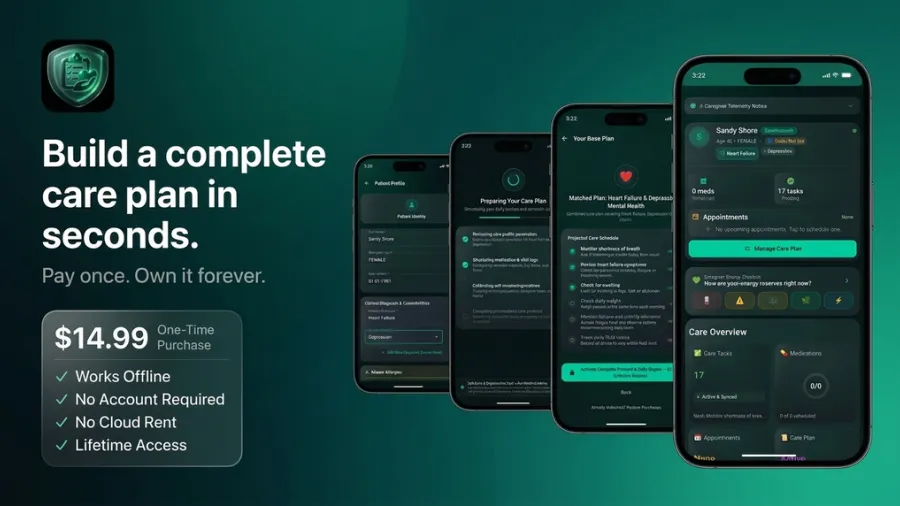
- No sign-up required. Open the app and start tracking immediately. No email, no password, no verification.
- No server-side data. Your health logs, medication records, symptom entries, wound tracking data, and care plans are stored in your phone’s secure Android sandbox. There is no cloud storage. There is no server.
- No third-party SDKs. No analytics. No advertising trackers. No crash reporting services that collect usage data. The app functions offline except for optional in-app purchase verification through Google Play’s billing API, which transmits only transaction metadata.
- No behavioral profiling. Because there’s no server to send data to, there’s no way to build a profile on you. Your usage patterns stay on your device.
- No data retention after deletion. When you delete the app, your data is gone. Everything is on your device. No remote copies. No “anonymized” backups. No surprises.
- No business model dependency on your data. ProCare Health doesn’t need your health data to make money. It doesn’t sell ads. It doesn’t share data. Your privacy isn’t a feature — it’s the architecture.
This isn’t a limitation. It’s a design choice. Every health app that requires an account is making a different choice — the choice to store your data somewhere other than your phone. And every time you make that choice, you’re trusting a company to keep its promises.
With ProCare Health, you don’t need to trust anyone. Your data stays on your device because there is no other place for it to go.
This is not medical advice. Consult your healthcare provider for medical decisions. This article discusses data privacy architecture and is not a substitute for professional medical or legal guidance.
Track your health data without an account in ProCare Health. All your data stays on your device. No account required.
References
Flo / FTC Settlement (2021) — Federal Trade Commission, “Developer of Popular Women’s Fertility-Tracking App Settles FTC Allegations That It Misled Consumers About Privacy of Their Sensitive Health Information.” Flo sent users’ health data to Facebook, Google, and other advertising networks despite promising privacy. ftc.gov/news-events/news/press-releases/2021/01/developer-popular-womens-fertility-tracking-app-settles-ftc-allegations-it-misled-consumers-about
BetterHelp / FTC Order (2023) — Federal Trade Commission, “FTC Gives Final Approval to Order Banning BetterHelp from Sharing Sensitive Health Data for Advertising.” BetterHelp uploaded over 7 million email addresses to Facebook, matching over 4 million to Facebook user IDs. ftc.gov/news-events/news/press-releases/2023/07/ftc-gives-final-approval-order-banning-betterhelp-sharing-sensitive-health-data-advertising
Calm / Meta Pixel Investigation — ClassAction.org, investigation into Calm app’s use of Meta pixel to record user health data and transmit it to Facebook. classaction.org/calm-app-vppa-investigation
HHS Office for Civil Rights — Healthcare Data Breach Reports — HHS, annual summary of healthcare data breaches affecting 500+ records. Over 72 million healthcare records breached in 2023 alone. ocrportal.hhs.gov/ocr/privacy/hipaa/consequences/
Local-First is the Only Responsible Architecture for AI + Health Data — Cascade Protocol, analysis of how account-based health apps create data collection points and why local-first architecture eliminates that risk. cascadeprotocol.org/blog/local-first-health-ai
Why Your Health Data Belongs on Your Device (Not the Cloud): A Local-First Manifesto — Dev.to, practical explanation of local-first architecture and the trade-offs between account-based and no-account health apps. dev.to/beck_moulton/why-your-health-data-belongs-on-your-device-not-the-cloud-a-local-first-manifesto-3nj
Health Data Monetization Laws Explained: HIPAA, GDPR, CCPA, and State Rules — AccountableHQ, analysis showing that state privacy laws are reactive and limited — they don’t prevent data collection, only give you rights over it after the fact. accountablehq.com/post/health-data-monetization-laws-explained-hipaa-gdpr-ccpa-and-state-rules
A Local-First Architecture for Privacy-Preserving Personalization in iOS Health Applications — American Impact Review, research on how health apps process sensitive signals and the architecture problem of where raw signals are transformed, stored, linked, and exported. americanimpactreview.com/articles/e2026058.pdf
Where Does Your Medication Data Actually Go? The Case for Local-First Architecture — Dev.to (Wellnest), explanation of how account-based medication apps collect and potentially expose data, including insurance implications and law enforcement subpoenas. dev.to/wellnestapp/where-does-your-medication-data-actually-go-the-case-for-local-first-architecture-5a8i
Private Health Tracking on iPhone: Local-First vs Cloud Peptide Apps — Vitadel Protocol, practical guide to identifying local-first apps: airplane mode test, account requirements, offline functionality, and SDK inspection. vitadel.com/protocol/guides/private-health-tracking-iphone