· Privacy · 9 min read
Why Your Health Data Belongs on Your Phone, Not a Server
The track record of health apps that promise privacy is terrible. Here's why local-first storage is the only real solution — and what happens when companies lie about it.

You hand your health data to an app with a promise: your information stays private. You enter your blood pressure, your symptoms, your sleep patterns, your medication schedule. You trust the app with things you wouldn’t tell your doctor in a waiting room.
Then someone sells that data.
It’s not a hypothetical risk. It’s happened — repeatedly, to well-known apps that promised privacy and delivered surveillance instead.
The Flo Case: When “Private” Means “We’ll Tell Facebook Anyway”
Flo, the period and fertility tracking app used by over 100 million people, promised users that their health data would stay private. Their privacy policies explicitly stated that information about marked cycles, pregnancy, symptoms, and notes would not be shared with third parties.
In reality, Flo sent users’ health data to Facebook, Google, Flurry, and AppsFlyer from 2016 to 2019. This included Custom App Events that conveyed sensitive health information — like when a user was having her period or had indicated an intention to get pregnant — through Facebook’s analytics SDK. The data was used to personalize ads and improve Facebook’s advertising products.
The FTC caught on and reached a settlement in 2021. Flo was prohibited from misrepresenting its data practices and ordered to notify affected users. In a related class action lawsuit (Frasco v. Flo Health), plaintiffs alleged that Flo also sold access to this health data to companies including Procter & Gamble and Bayer under contracts totaling millions of dollars.
The damage was already done. Millions of users had their most intimate health information funneled into advertising networks without their knowledge or consent.
BetterHelp: Mental Health Data as Advertising Fuel
The same pattern played out with BetterHelp, the online counseling platform. BetterHelp promised users that their personal health information would not be used or disclosed except for limited purposes — namely, to provide counseling services.
Instead, from 2013 to 2020, BetterHelp handed consumers’ email addresses, IP addresses, and health questionnaire responses to Facebook, Snapchat, Pinterest, and Criteo for advertising purposes. They uploaded lists of over 7 million email addresses to Facebook, which matched over 4 million of them to Facebook user IDs — effectively linking people’s mental health treatment to their social media profiles.
The FTC finalized an order in 2023 requiring BetterHelp to pay $7.8 million to consumers and banning them from sharing health data for advertising. Another privacy promise broken. Another settlement.
Calm and the Meditation Paradox
Even Calm — the meditation and sleep app that literally asks you to “take a deep breath” — was found to be using the Meta pixel to record which videos users watched and transmitting that information to Facebook along with each user’s Facebook ID. Calm also sent health questionnaire responses to third-party advertising companies.
A wellness app. A meditation app. An app designed to reduce your stress. And it was feeding your health data into an advertising engine.
The 2019 Wall Street Journal Investigation
In 2019, the Wall Street Journal conducted testing that revealed a disturbing pattern across the health app ecosystem. Apps that collected intensely personal information — diet, exercise, heart rate, menstrual cycles, pregnancy status — were sending that data to Facebook immediately after it was recorded.
This happened even when users had no Facebook account. Even when users weren’t logged into Facebook. The data flowed through Facebook SDKs embedded in the apps, often without any prominent disclosure to the user.
The WSJ found that ovulation trackers, heart rate monitors, and other health apps were sharing user data with Facebook within seconds of it being entered. And Apple and Google — the companies that operate the app stores — don’t require apps to disclose all the partners that user data is shared with.
MyFitnessPal: When a Breach Is the Best-Case Scenario
Then there are the breaches. MyFitnessPal, owned by Under Armour, suffered a data breach in 2018 that exposed 150 million accounts. Usernames, email addresses, and hashed passwords were compromised in one of the largest hacks in history.
This is the best-case scenario for a health app: a data breach. The worst case is when the app shares your data with third parties without a breach — because then you never even know it happened.
Sutter Health and Lemonaid Health: Tracking Pixels in Healthcare
The problem isn’t limited to consumer apps. In 2023, Sutter Health, a major California healthcare system, settled a class action lawsuit over transmitting patients’ protected health information to Meta and Google via tracking pixels on its website and patient portal. Lemonaid Health, a telehealth platform, faced the same allegations.
Patients filling out health forms on a hospital website had their information silently forwarded to advertising networks. No breach. No hack. Just standard web analytics, working exactly as designed.
What This Means for You
Every one of these companies promised privacy. Every one of them had a privacy policy that said, in effect, “we don’t share your health data.” Every one of them was wrong.
Here’s the pattern:
- The app collects your health data — often with SDKs that automatically share it with third parties
- The privacy policy makes promises — but the fine print allows sharing with “analytics partners” or “service providers”
- Your data ends up in advertising networks — where it’s used to build profiles, personalize ads, and train machine learning models
- You never know — because the data transfer happens silently, in the background, without any notice
And here’s the uncomfortable truth: there is no way to verify that an app is keeping its promises. You can read the privacy policy. You can check the app’s permissions. But the actual data flow happens inside the app’s code, and you can’t audit that from the outside.
The Only Real Solution: Local-First
If you can’t verify that a company is protecting your health data, the only way to protect it is to ensure it never leaves your device in the first place.
Cloud-Based Health Apps vs. Local-First Architecture
| Cloud-Based Health Apps | Local-First Apps | |
|---|---|---|
| Where your data lives | On the company’s servers | On your phone |
| Account required | Yes — to sync your data | No — nothing to sync |
| Third-party SDKs | Common (analytics, ads, crash reporting) | None needed |
| Data shared with advertisers | Yes, via SDKs or data brokers | No — it never leaves your device |
| Breach risk | High — servers are targets | Only if your device is compromised |
| Uninstall = data gone? | No — copies exist on their servers | Yes — everything is on your device |
| Offline use | Often limited or broken | Full functionality, always |
This is what “local-first” means: your health data is stored in your phone’s secure sandbox. It is not uploaded to any cloud server. It is not transmitted to any analytics provider. There are no third-party SDKs collecting data in the background. No account required, because there’s nothing to sync.
When you uninstall the app, your data is gone. There are no remote copies. No data breaches. No surprises. (Note: if you back up your phone to iCloud or Google Drive with unencrypted backups, those system-level backups may still store your app’s data on third-party servers — this is a device-level setting, not an app-level one, and most users won’t even know it’s happening.)
This isn’t a technical limitation. It’s a design choice. Every health app that requires an account, that syncs to the cloud, that uses analytics SDKs — that’s a choice to store your data somewhere other than your phone. And every time you make that choice, you’re trusting a company to keep its privacy promises.
The Bottom Line
Your health data is the most sensitive information you carry. It includes things about your body, your mind, your habits, your conditions — details you might not share with anyone.
For heart failure patients tracking daily weight and breathing patterns, for caregivers documenting wound healing between professional visits, for anyone logging symptoms that their doctor needs to see — this isn’t abstract data. It’s the difference between catching a problem when it’s manageable and discovering it when it’s an emergency. How to log heart failure symptoms and Five signs your caregiver should start tracking wound healing at home are examples of the kind of sensitive health information that deserves local-first protection, not cloud storage.
The track record of companies that ask you to trust them with that data is not reassuring. Promises of privacy are meaningless when the technology they use to deliver their service inherently collects and shares that data.
The only way to guarantee your health data stays yours is to store it on your device, process it on your device, and export it only when you decide.
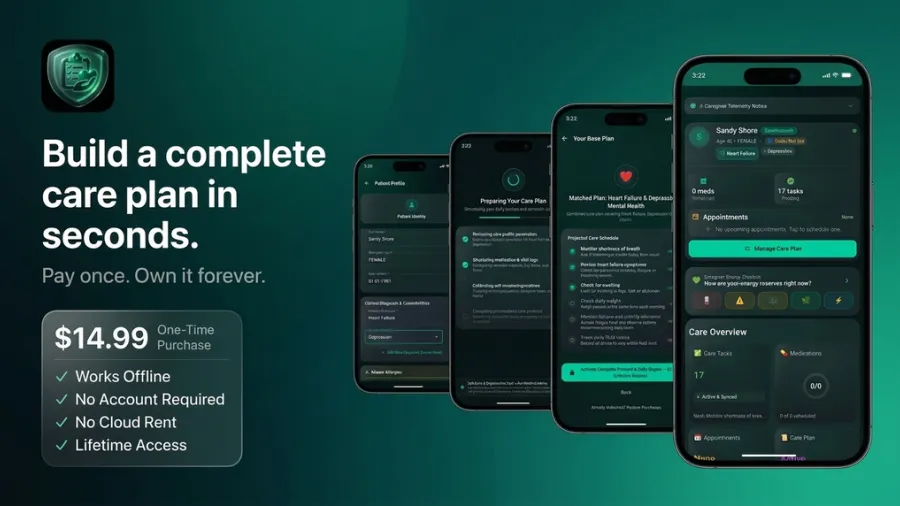
That’s what we built ProCare Health to do. No cloud. No accounts. No tracking. No third-party SDKs. Just your data, on your phone, where it belongs.
This is not medical advice. Consult your healthcare provider for medical decisions. This article discusses data privacy practices and is not a substitute for professional medical guidance.
Track your health data locally in ProCare Health. All your data stays on your device. No account required.
References
Flo / FTC Settlement (2021) — Federal Trade Commission, “Developer of Popular Women’s Fertility-Tracking App Settles FTC Allegations That It Misled Consumers About Privacy of Their Sensitive Health Information.” ftc.gov/news-events/news/press-releases/2021/01/developer-popular-womens-fertility-tracking-app-settles-ftc-allegations-it-misled-consumers-about
Flo / FTC Complaint — Federal Trade Commission, Flo Health, Inc. Complaint. ftc.gov/system/files/documents/cases/flo_health_complaint.pdf
Flo / Class Action (Frasco v. Flo Health) — Frasco v. Flo Health, Inc., U.S. District Court for the Northern District of California, Case No. 3:21-cv-00757. Plaintiffs’ consolidated amended complaint alleges Flo sold Custom App Event data to Procter & Gamble and Bayer. periodtrackerdataprivacylitigation.com
BetterHelp / FTC Order (2023) — Federal Trade Commission, “FTC Gives Final Approval to Order Banning BetterHelp from Sharing Sensitive Health Data for Advertising.” ftc.gov/news-events/news/press-releases/2023/07/ftc-gives-final-approval-order-banning-betterhelp-sharing-sensitive-health-data-advertising
BetterHelp / FTC Complaint — Federal Trade Commission, BetterHelp, Inc. Complaint, Paragraph 52 (over 7 million emails uploaded to Facebook, 4 million matched to user IDs). ftc.gov/system/files/ftc_gov/pdf/2023169-betterhelp-complaint_.pdf
Calm / Meta Pixel Investigation — ClassAction.org, “Calm App Privacy Violations Investigation.” classaction.org/calm-app-vppa-investigation
2019 WSJ Investigation — The Wall Street Journal, “Facebook Reportedly Gets Deeply Personal Info, Such as Ovulation Times and Heart Rate, from Some Apps.” cnbc.com/2019/02/22/facebook-receives-personal-health-data-from-apps-wsj.html; also covered by The Verge and 9to5Mac.
MyFitnessPal Breach (2018) — NBC News / Under Armour official notice, “Under Armour Says Data Hacked from 150M MyFitnessPal App Accounts.” nbcnews.com/tech/security/under-armour-says-data-hacked-150m-myfitnesspal-app-accounts-n861406
Sutter Health Pixel Settlement — HIPAA Journal, “Sutter Health, Lemonaid Health, & Redeemer Health Settle Pixel Data Breach Lawsuits.” hipaajournal.com/sutter-health-lemonaid-health-redeemer-health-pixel-data-breach-settlements
Lemonaid Health Pixel Settlement — SEC Filing, In re Chrome Holding Co. Chapter 11 Cases, Exhibit 99.2 (class action over tracking pixels on lemonaidhealth.com). sec.gov/Archives/edgar/data/1804591/000119312525182189/d60496dex992.htm